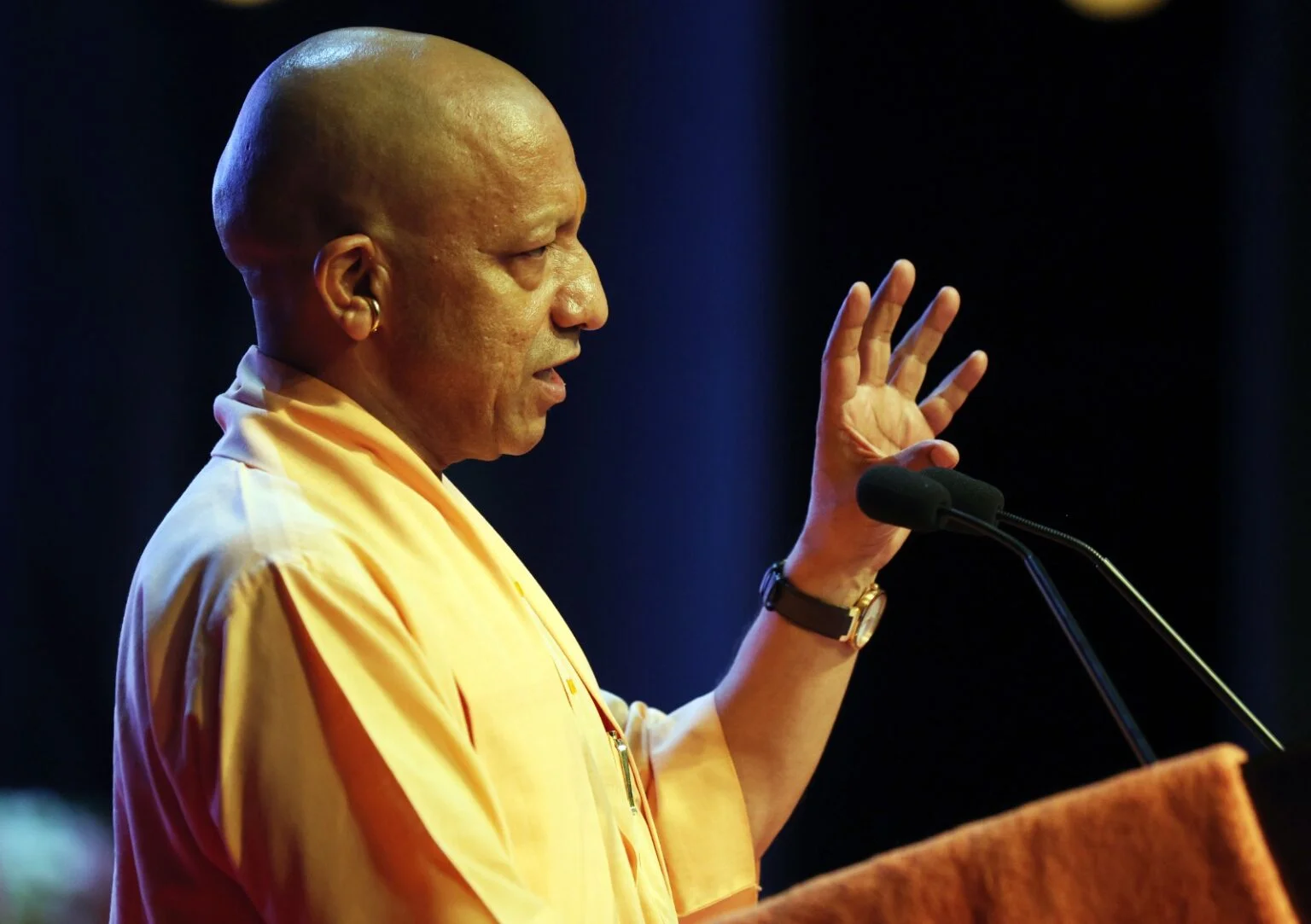
Mathura: Uttar Pradesh Chief Minister Yogi Adityanath said on the occasion of Shri Krishna Janmashtami that India’s civilisational and spiritual traditions had survived centuries of invasions and attempts to erase its cultural identity.
Speaking from Mathura, the Chief Minister said foreign invaders may have destroyed temples, but they could not weaken the devotion of the people or bring an end to traditions associated with Lord Krishna, Radha and other revered figures.

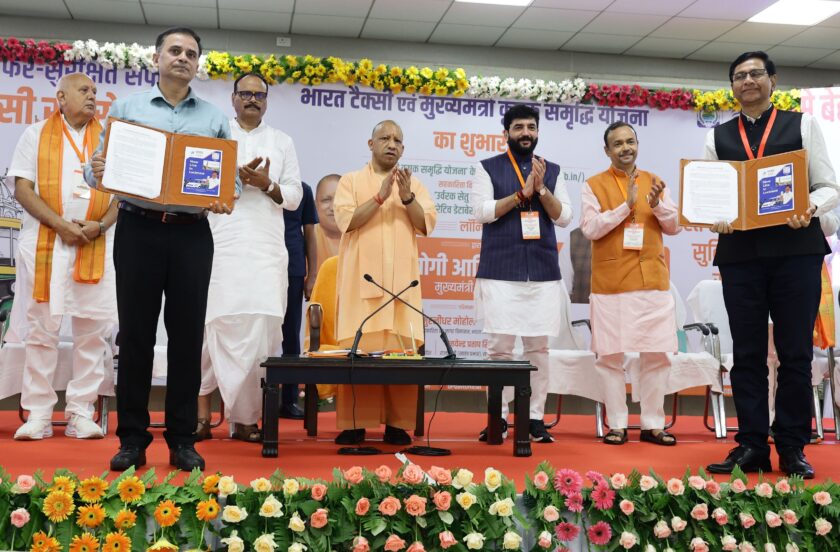
Yogi Adityanath inaugurated and laid the foundation stones for 229 development projects worth ₹1,051 crore in Mathura. The package includes 62 projects worth more than ₹540 crore that were inaugurated and 167 projects costing over ₹437 crore for which foundation stones were laid. More than ₹72 crore was also transferred to beneficiaries of housing schemes.
The Chief Minister inaugurated the Swami Haridas Auditorium at the Geeta Research Institute and Raslila Academy in Vrindavan and used the occasion to underline the importance of preserving Braj’s cultural heritage while simultaneously developing its tourism infrastructure.
‘India’s history is one of preservation and reconstruction’
Yogi said India’s history should not be viewed merely through the lens of achievements. It is also a history of struggle, preservation, reconstruction and continuity of its ancient traditions.
He cited Mathura as a prominent example, saying the region had witnessed repeated attacks on temples and religious institutions, yet festivals and traditions associated with Braj continued uninterrupted.
He referred to the traditions of Janmashtami in Mathura, devotion in Vrindavan, Holi in Barsana and the Govardhan Parikrama as examples of cultural practices that survived historical upheavals.
The Chief Minister also highlighted the contribution of saints such as Swami Haridas, who, he said, transformed devotion into a form of musical practice and connected it with wider social consciousness. Legendary musician Tansen was among his disciples, he noted.
Development must include heritage
Yogi Adityanath said development had traditionally been viewed largely through infrastructure such as roads, electricity, water, buildings and industries. However, he argued that development must also include the preservation and revival of India’s cultural heritage.
He said India’s heritage extends beyond monuments and temples to languages, literature, music, art, philosophy, mathematics, science, medicine, astronomy and traditional knowledge systems.
The Chief Minister said the government’s approach was to combine heritage, development, faith, economy, tradition and modernity.
He pointed to the development of pilgrimage and heritage destinations including Ayodhya, Kashi, Mathura, Vrindavan, Barsana, Govardhan, Nandgaon, Baldev, Vindhyachal, Chitrakoot, Shukteerth, Naimisharanya, Sarnath and Kushinagar.
According to the Chief Minister, improved connectivity, infrastructure and law and order have helped Uttar Pradesh attract large numbers of visitors, with 156 crore tourists visiting the state last year, according to figures cited in his address.
Law and order linked to tourism and investment
Yogi said a strong rule of law was essential for tourism, investment and social confidence. He contrasted the current situation with the period before 2017, when, according to him, several parts of Uttar Pradesh witnessed communal disturbances.
He said the state had moved from concerns about disruptions during festivals to preparations for large-scale celebrations.
The Chief Minister highlighted major religious events, including Ram Navami, Deepotsav, Durga Puja, processions and the Mahakumbh, as examples of festivals now being organised with large-scale administrative and security arrangements.

He also referred to the 2016 Jawahar Bagh incident in Mathura, in which 29 people, including two police officers, died during violence, while arguing that such incidents had previously posed challenges to the state’s ability to safely organise major public celebrations.
Major tourism push for Braj
The Chief Minister said the Braj Teerth Vikas Parishad had completed several projects worth around ₹1,000 crore over the past eight years.
The government is developing Vrindavan, Barsana, Nandgaon, Govardhan, Radha Kund, Gokul, Baldev and Mathura as interconnected tourism destinations. Work is also being undertaken on the 84-kosi and Panchkosi pilgrimage routes and the restoration of traditional ponds.
Yogi said proposals for a ropeway in Vrindavan, a mega parking facility and the Raya Urban Node near Mathura were aimed at creating modern infrastructure for the region’s future tourism needs.
He also referred to the establishment of the Surdas Braj Bhasha Academy for the preservation and promotion of the Braj language and cultural traditions.
A 400-acre city forest, Saurabhi Van, is also being developed within the urban limits of Vrindavan, according to the Chief Minister.
‘Braj’s development is changing the ground reality’
Former state minister and BJP MLA Shrikant Sharma highlighted infrastructure improvements in Mathura-Vrindavan, saying roads, bridges and public facilities had expanded significantly since 2017.
He said areas that previously faced muddy roads and potholes now have paved and interlocking roads. He also highlighted the construction of three bridges across the Yamuna, including one near Laxmi Nagar in Mathura and two in Vrindavan.
Sharma said the road from Bhuteshwar to Rangji Temple had been widened and illuminated, while improvements had also been made on routes connecting Bhuteshwar, Govardhan Chauraha, Govardhan and the Deeg border.
32 of 36 drains diverted from Yamuna
Sharma also claimed that 32 of the 36 drains that previously discharged into the Yamuna in Mathura-Vrindavan have been tapped.
According to him, the remaining four drains are expected to be tapped by October, further reducing untreated wastewater entering the river.
He also referred to the transformation of Jawahar Bagh and the development of facilities along the 84-kos Braj pilgrimage circuit.
The government has sought to position these projects as part of a broader strategy to combine cultural preservation with infrastructure development, tourism, employment and improved civic facilities.
Addressing the gathering from the birthplace of Lord Krishna, Yogi Adityanath said India’s path towards becoming a developed and self-reliant nation must remain connected to its civilisational roots, while ensuring opportunities and development for women, youth, farmers, entrepreneurs, artisans and other sections of society.